
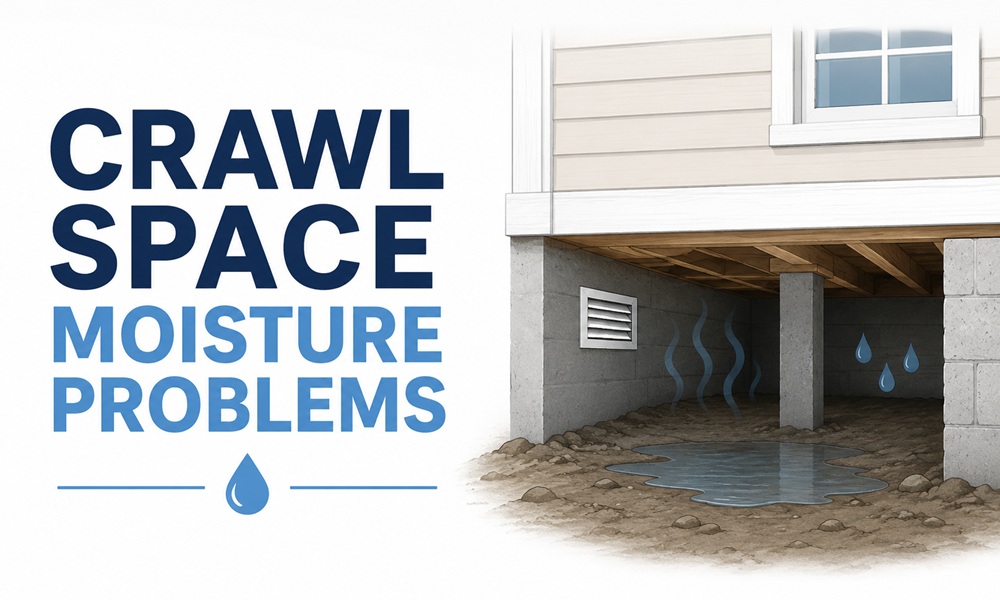
The space under your floor is out of sight, so its problems usually announce themselves upstairs — as musty air, bouncy floors, and creeping energy bills. Catching it early is far cheaper than repairing rot.
| QUICK ANSWER Crawl space moisture shows up as musty odors, high indoor humidity, mold, condensation, sagging or springy floors, and rising energy bills. The usual causes are ground moisture, humid outside air entering through vents, and plumbing or drainage leaks. Keep humidity below 60% (30–50% is ideal). The longest-lasting fix is full encapsulation, not a bare vapor barrier alone. |
Warning signs your crawl space has a moisture problem
Most homeowners never look under the house until something feels wrong above it. Watch for these.
- Musty or earthy smells rising into living areas — damp air travels upward.
- High indoor humidity that the air conditioner struggles to beat.
- Visible mold or mildew on joists, subfloor, or insulation.
- Condensation on pipes, ducts, or the underside of the floor.
- Sagging, springy, or uneven floors, a sign of rot in the floor joists.
- Wet, sagging, or fallen insulation, which then breeds more mold.
- Standing water, mud, or damp soil after rain.
- Pests, drawn to the damp and the rotting wood.
- Higher energy bills, as humid air is harder to heat and cool.
What causes the moisture in the first place?
Damp doesn’t appear from nowhere. Three sources cause most cases, often together.
- Ground moisture rising from bare soil. Without a barrier, the earth releases water vapor straight up into the space.
- Humid outside air through open vents. Many older homes have vented crawl spaces meant to “breathe.” In practice, warm humid air enters, hits cooler surfaces, and condenses — the vents often let in more moisture than they release.
- Plumbing leaks and poor drainage. Leaky pipes, sewage backups, clogged gutters, and grading that slopes toward the house push water underneath.
A seasonal trap worth knowing: in cooler months, warm summer-temperature air meeting cold surfaces creates condensation — a perfect breeding ground for mold even without an obvious leak.
What humidity level should a crawl space be?
Use a number, not a guess. A cheap hygrometer settles the argument.
| Relative humidity | What it means | Action |
| 30–50% | Optimal — discourages mold, rot, and pests. | Maintain and inspect twice a year. |
| 50–60% | Acceptable upper edge. | Monitor; improve control before summer. |
| Above 60% | Mold and wood-rot risk climbs fast. | Add dehumidification and find the source. |
Which fix actually solves it?
Solutions range from a quick patch to a full system. The right one depends on how bad the problem is and how permanent you want the result.
| Solution | What it does | Best when |
| Vapor barrier only | Plastic sheeting over the soil to block rising ground moisture. | Mild cases; one piece of a bigger fix, not a complete solution. |
| Dehumidifier | Pulls moisture from the air to hold humidity in range. | Works best paired with a barrier and sealed vents, not alone. |
| Drainage / sump | Moves liquid water away from under the home. | Standing water, runoff, or a high water table. |
| Full encapsulation | Seals floor and walls with a heavy barrier, closes vents, adds a dehumidifier and often drainage. | Persistent moisture, or for maximum long-term protection. |
| The distinction the top results blur: a vapor barrier is not encapsulation A vapor barrier is one layer of a complete system. Full encapsulation seals the walls and vents, manages liquid water, and controls humidity — which is why it lasts. Replacing wet insulation without fixing the moisture source is wasted money; the new insulation soaks through again. Done properly, a quality encapsulation system can last 20 years or more, lower energy bills, improve indoor air quality, and even help a home’s resale value. Context worth noting: only a small share of new homes are built on crawl spaces today (most use slab foundations), so this is increasingly a maintenance issue for existing houses — especially in humid regions. |
Can you fix it yourself?
Some of it. Closing obvious gaps, clearing gutters, fixing grading, laying a basic barrier, and running a dehumidifier are within reach for a confident DIYer. But persistent moisture, structural sagging, or full encapsulation usually needs a professional who can find the hidden source and install a sealed system correctly.
Inspect the space at least twice a year — ideally spring and fall — for new cracks, leaks, condensation, and pests. Early action prevents the costly repairs.